VAT Accounting & Bookkeeping Services in Dubai and UAE

VAT compliance is more than filing a return. Your invoices, input VAT claims, credit notes, imports, and accounting ledgers must support the figures submitted to the Federal Tax Authority.

Our VAT accounting service helps UAE businesses record VAT correctly, reconcile VAT accounts, prepare VAT 201 returns, and file through EmaraTax on time. We also review recoverable input VAT, check supporting documents, support FTA queries, and help you prepare for UAE e-invoicing changes.

  • VAT bookkeeping and reconciliation
  • VAT 201 preparation and EmaraTax filing
  • Input VAT review and recovery checks
  • FTA-ready records and audit support
  • E-invoicing readiness guidance

Enquire Now

What our VAT accounting service includes

VAT accounting needs more than entering invoice totals. Each return should be supported by clean records, proper VAT treatment, and reconciliations that match your accounting system.

VAT bookkeeping

We record sales invoices, purchase invoices, credit notes, expenses, and VAT entries in line with UAE VAT requirements. Your records stay organised and ready to support the VAT return if the FTA asks for details.

VAT return preparation and filing

We calculate output VAT, review recoverable input VAT, check invoices and VAT ledgers, prepare your VAT 201 return, and file it through EmaraTax before the deadline.

VAT reconciliation

Before filing, we compare the VAT return with your sales records, purchase records, general ledger, and bank or payment records. This helps catch wrong figures, missed claims, and mismatches before the return is submitted.

Input VAT review

Not every VAT amount on an expense invoice can be claimed. We review input VAT claims and flag items that need care, including blocked expenses, mixed-use costs, exempt supplies, and missing tax invoice details.

VAT advisory

We guide you on the VAT treatment of your actual transactions, including reverse charge, imports, zero-rated supplies, exempt income, intercompany transactions, and free zone activity where relevant.

FTA query and audit support

If the FTA asks for clarification or opens a review, we help prepare the records, reconcile the periods under review, and support your communication with the authority.

Vat points

UAE VAT points every business should know

The standard VAT rate in the UAE is 5%. VAT registration is mandatory when taxable supplies and imports exceed AED 375,000 in a 12-month period. Voluntary registration may apply from AED 187,500.

Once registered, a business must keep proper VAT records, issue compliant tax invoices, file VAT returns on time, and pay any VAT due within 28 days from the end of the tax period.

VAT accounting connects your daily bookkeeping with the return submitted to the FTA. If the records, invoices, and VAT ledgers do not agree, the filing can be wrong even when the final number looks correct.

VAT changes in the UAE for 2026 and 2027

UAE VAT compliance is changing around e-invoicing, reverse charge records, and refund claim timing. These points should be reviewed early so your accounting system and VAT records are ready before the deadline.

UAE e-invoicing rollout

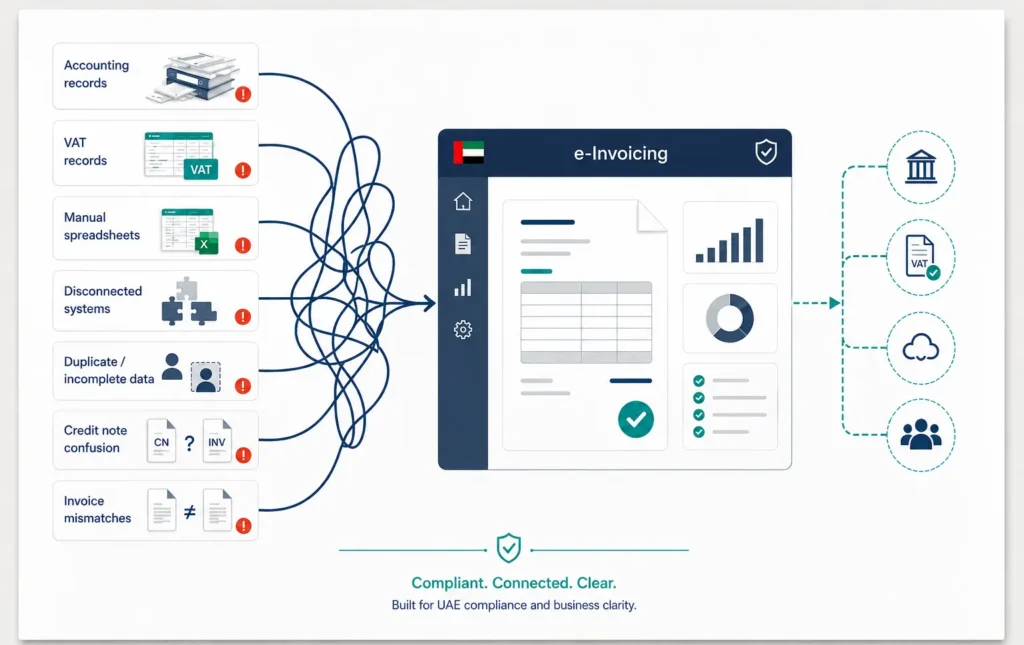
The UAE is moving to structured e-invoicing. AED 50M+ revenue businesses must appoint an Accredited Service Provider by 30 October 2026 and go live by 1 January 2027. Other businesses follow later, and PDF invoices will not qualify once their phase applies.

Reverse charge documentation

From 1 January 2026, businesses are no longer expected to raise internal self-invoices for reverse charge transactions. Supplier invoices, import documents, and supporting records become more important because the VAT treatment still needs to be recorded correctly.

Five-year VAT refund claim limit

VAT refund claims are now tied to a five-year time limit. If your business has old input VAT credits or unclaimed refundable balances, those records should be reviewed before the claim window closes.

Need help checking your VAT position? We can review your VAT records, filing process, and e-invoicing readiness so you know what needs to be fixed before your next deadline.

vat accounting support

Who needs VAT accounting support?

  • VAT-registered businesses that want accurate monthly or quarterly VAT records
  • Small businesses filing VAT returns for the first time
  • Trading, retail, and e-commerce companies with high invoice volume
  • Importers dealing with reverse charge and customs documentation
  • Free zone companies with taxable, zero-rated, or exempt activity
  • Businesses with old VAT credits, missed claims, or previous filing errors
  • Companies preparing for UAE e-invoicing requirements
  • Businesses using Zoho Books, QuickBooks, Xero, Tally, or Excel records
  • Businesses that received an FTA clarification request or audit notice

How we handle your VAT accounting

1
Review VAT records
We check your VAT registration details, tax period, invoicing process, bookkeeping records, and past VAT filings where needed. This helps identify gaps before the next return is prepared.
2
Record transactions
Sales, purchases, imports, expenses, credit notes, and VAT adjustments are recorded properly in your accounting system so the VAT return is based on clean records.
3
Reconcile before filing
We match the VAT return figures against your ledgers, invoices, and supporting documents before submission. This helps catch mismatches, missed claims, and incorrect VAT entries.
4
Prepare and file VAT 201
Your VAT 201 return is prepared and submitted through EmaraTax within the 28-day filing deadline, with output VAT, input VAT, adjustments, and net VAT checked before filing.
5
Advise on next steps
If something in your records needs attention, we explain it before the next filing period. You receive clear action points for corrections, missing documents, or VAT treatment issues.
Why us

Why choose us for VAT accounting in the UAE?

  • Review before filing: VAT returns are checked against invoices, ledgers, and supporting records before submission.
  • Practical VAT treatment: We look at how your business actually sells, buys, imports, and claims VAT.
  • FTA-ready records: We help keep the documents behind each VAT return organised and easy to explain.
  • Support for UAE VAT changes: We help clients prepare for e-invoicing, reverse charge documentation changes, and VAT refund claim timing.
  • One point of contact: You deal with one team for VAT bookkeeping, return filing, reconciliations, and FTA queries.
  • Clear pricing: The scope and fee are agreed before work starts.
Frequently Asked Questions (FAQs)

What is VAT accounting in the UAE?

VAT accounting is the process of recording, reviewing, reconciling, and reporting VAT on business transactions. It covers sales VAT, purchase VAT, input VAT claims, imports, reverse charge entries, credit notes, and VAT return filing.

What is the current VAT rate in the UAE?

The standard VAT rate in the UAE is 5% on most taxable goods and services.

When does VAT registration become mandatory in the UAE?

VAT registration is mandatory when taxable supplies and imports exceed AED 375,000 in a 12-month period. Voluntary VAT registration may apply from AED 187,500.

How often do businesses file VAT returns in the UAE?

Most UAE businesses file VAT returns quarterly. Businesses with annual turnover of AED 150 million or more are usually assigned monthly filing. The FTA can also assign a different tax period in some cases. Your exact filing period appears in your EmaraTax account and VAT registration details.

What is VAT 201?

VAT 201 is the UAE VAT return form submitted through EmaraTax. It reports output VAT, input VAT, adjustments, and the net VAT payable or refundable for the tax period.

Do I need to prepare for UAE e-invoicing now?

If your annual revenue is above AED 50 million, preparation should already be underway because the full implementation date is 1 January 2027. Smaller businesses should also review their invoicing system and timeline so they are not forced into a rushed change later.

Can you help if previous VAT returns have errors?

Yes. We can review past VAT returns, compare them with your accounting records, identify the issue, and advise on the correct next step based on the type of error and the FTA process.

Can a business handle VAT accounting on its own?

Yes, especially if the business has simple transactions. The risk usually comes from details such as missed reverse charge entries, incorrect input VAT claims, incomplete tax invoices, or filing under the wrong tax period. A review before filing can help prevent costly mistakes.
×

Hold On!

Not Sure? Connect With a VAT Consultant

Get professional guidance on UAE VAT registration, filing, accounting, deregistration, reclaim